Foaming vs liquid hand soap sounds like a choice between two different products, but foaming soap is a liquid soap too. The difference is in the pump, which mixes the soap with air on the way out, so it lands in your palm as foam.
We make one of the two. Our Hand Wash is a liquid soap, and we do not sell a foaming version. Below is how each one works, what the research says about cleaning, what to look for on a non-toxic label and how the cost compares.
The short answer
Use whichever you like, and scrub for 20 seconds. In a small 2017 study, liquid soap reduced the bacteria on hands more than plain foam soap did, while a 2016 study found no clear overall difference, so liquid gets only a slight edge. The CDC's steps are the same for both: wet, lather, scrub for at least 20 seconds, rinse and dry.
Foaming vs liquid hand soap at a glance
Liquid edges it, but your scrub decides
- One small study favored liquid, another found no clear gap
- The CDC's 20-second scrub applies to both
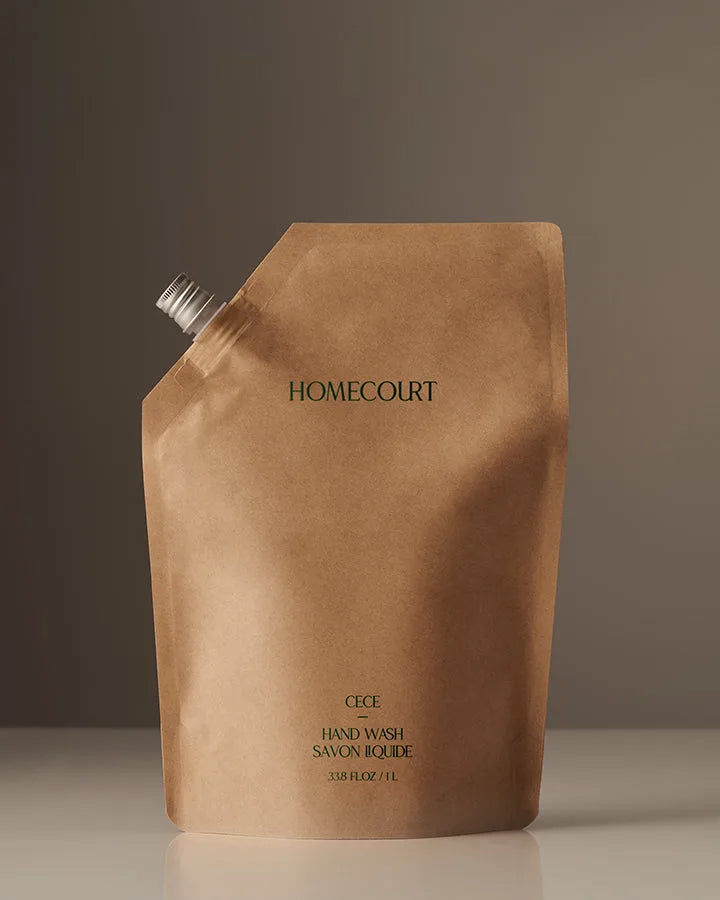
- We make a liquid Hand Wash, with a 1L refill
Most of the foaming vs liquid hand soap question is about feel. Foam arrives already whipped and spreads fast. Liquid comes out as a gel, and you build the lather yourself, as our Hand Wash directions put it: pump, add water, massage into a rich lather, rinse.
Neither format makes a soap gentle or harsh; the formula does. A non toxic hand soap is defined by its ingredient list, and the same kind of list can sit behind either pump.
| Feature | Liquid hand soap | Foaming hand soap |
|---|---|---|
| Comes out as | A gel you lather with water | Foam, mixed with air in the pump |
| Pump | A standard pump | A foam pump with a mixing chamber |
| Lather | Built as you scrub | Ready the moment it lands |
| Cleaning evidence | Ahead in one small study, even in another | Behind in one small study, even in another |
| What to compare | Price per fl oz on the label | Price per fl oz on the label |
| At Homecourt | Hand Wash, $36 for 12 oz, plus a 1L refill | We do not make a foaming soap |
How foaming hand soap works
Soap, air & a fine mesh
Foaming hand soap starts out as a liquid in the bottle, and the pump does the work. A foaming soap dispenser moves soap and air together and pushes them through small openings, so the liquid becomes lather before it reaches your hand. See soap dispensers on Wikipedia for how these dual pumps work.
Its entry on foam pumps fills in the rest: a small chamber mixes the liquid with air and sends it out through a nylon mesh, which is why a foam pump has a wider neck than most other pumps.
Speed is the appeal, with nothing to work up. That head start is also the open question, since lather you build yourself comes with rubbing, and rubbing is part of what cleans.
Why liquid hand soap cleans differently
The lather you build yourself
Liquid hand soap reaches your palm as a concentrated gel, and the lather forms on your skin as you add water and scrub.
That rubbing does real work. According to the CDC, the surfactants in soap lift soil and microbes from skin, and scrubbing for at least 20 seconds removes more germs than washing for a shorter time.
For a head-to-head, we found two small studies. A short 2017 report in the American Journal of Infection Control ran three experiments with two brands of foam soap and found plain foam soap was not as effective at reducing the bacteria on hands as liquid soap. A 2016 University of Arkansas study of 24 volunteers found no significant difference between foaming and liquid soap in overall removal of E. coli bacteria and the MS2 virus, though the foam removed significantly less of the virus than of the bacteria. Neither settles the question, but together they give liquid a slight edge this round.
Our Homecourt Hand Wash is a non toxic liquid hand soap. Coconut-derived surfactants do the cleaning, Australian hibiscus flower extract hydrates, and argan oil moisturizes. Our post on argan oil in hand wash explains what the oil adds.
Every ingredient is chosen to be non-toxic and safe for people and pets when used as directed, and the full list is on the product page. It comes in six fragrances, so skip it if you avoid scent. It won Esquire Grooming Awards in 2022 and 2023.

Non-toxic foaming hand soap: What to check
Read the back of the bottle
We do not make a non toxic foaming hand soap, so treat this as a guide to reading any label, ours included. What to look for is the same behind either pump.
- Every ingredient, in order, not just the front of the bottle.
- A named preservative. Ours are caprylhydroxamic acid and benzyl alcohol.
- How fragrance is listed. Most lists, ours too, use the single word fragrance. For dry, sensitive skin, the American Academy of Dermatology suggests products labeled fragrance-free.
- No antibacterial active. A 2016 FDA final rule took 19 active ingredients, triclosan and triclocarban among them, out of consumer liquid, foam and gel hand soaps.
On its own, the word non-toxic proves little. Under the FTC's Green Guides, a non-toxic claim likely tells shoppers a product is non-toxic for people and for the environment, so a company making it needs competent and reliable scientific evidence or should qualify the claim. Our guide to what non-toxic hand soap means walks through the ingredients worth knowing.
Asked for the best non toxic hand soap, we say judge the list first, then pick the format you will actually scrub with for 20 seconds.
Cost per wash & refills
What a wash really costs
Cost per wash is hard to pin down for either format, because almost no bottle says how much soap one pump delivers. A foam pump adds air, so a pump of foam looks like more soap than a pump of gel. It may hold less: when the same 2016 University of Arkansas study collected hand soap from food service businesses in one county, the foaming samples averaged 0.64 mL and the liquid samples 1.19 mL. Compare the price per fluid ounce on the label instead.
Refilling our Hand Wash with the Hand Wash Refill brings the price per ounce down:
- Bottle: $36 for 12 oz, or $3.00 per fl oz
- Refill, one-time order: $88 for 33.8 fl oz (1L), or $2.60 per fl oz
- Refill on Subscribe & Save: $79.20, or $2.34 per fl oz
Our kraft-paper pouch fills up to three bottles and reduces plastic use by 92%. Subscriptions take 10% off, ship free on every delivery, and can be skipped or paused.
If you have looked up how to make foaming hand soap, the usual method is to thin a liquid soap with water inside a foaming bottle. We have not tested our Hand Wash that way, so we cannot vouch for the result or give a ratio. It is made to be used as it comes, from its own pump.
Whatever you refill, empty and rinse the bottle first. In its hand hygiene guideline for health care settings, the CDC says not to add soap to a partly empty dispenser, because topping off can lead to bacterial contamination of the soap.
Foaming soap FAQ
Quick answers at the sink
Start with the big one: is foaming soap as effective as liquid soap?
Is foaming soap as effective as liquid soap?
The evidence is mixed. In a short 2017 report in the American Journal of Infection Control, plain foam soap was less effective than liquid soap at reducing the bacteria on hands, while a 2016 University of Arkansas study found no significant overall difference. Either way, technique decides most of the result: wet, lather, scrub for at least 20 seconds, rinse well and dry, as the CDC advises.
Can you put liquid soap in a foaming dispenser?
People do, usually after thinning it with water. We do not recommend it with our Hand Wash, which is made for the pump it ships with and has not been tested watered down. Keep it in its own bottle and refill that, emptied and rinsed first.
Which lasts longer per bottle?
It depends on the pump and how many pumps you use, and few bottles print either. In the foaming vs liquid hand soap math, watch the price per fluid ounce. Our 12 oz Hand Wash is $3.00 an ounce, and one 1L refill fills up to three bottles, so the bottle on your counter keeps going.
More Homecourt hand wash guides
Keep reading