
 Cleaners
Most kitchens hold more materials than people think. A granite counter meets a tile backsplash, which meets a stainless range, which sits beside painted or stained wood cabinets. Each one has its own maker, its own care guide and its own idea of what counts as gentle.
We make a Surface Cleaner, so we have a stake in this list. What we say about it comes from its label and product page. What we say about each material comes from the groups that study it and the makers' own care sheets.
The short answer
A plant-based kitchen spray like ours is made for sealed, non-porous surfaces. Homecourt Surface Cleaner's directions list finished wood, tile, sealed stone, stainless steel and granite. Our label does not list quartz, laminate or sealed concrete, so use mild dish soap and warm water there and follow the maker's care guide. Keep any spray off unsealed marble, raw wood and screens.
Surfaces a non-toxic kitchen cleaner can handle
Every surface in one table
A non toxic kitchen cleaner is a description, not a certification, so the label is where you find out what it is actually for. The directions on a non-toxic kitchen cleaner like ours read: spray directly onto non-porous surfaces, including finished wood, tile, sealed stone, stainless steel and granite, loosen grease and debris with a lint-free cloth, sponge or towel, and wipe away any excess moisture.
That list covers most of a kitchen, so the kitchen cleaner question comes down to the few surfaces it does not name. For how to clean tile, see item 06. The table shows what is on our label and what to watch on each surface.
| Surface | On our label | Watch for |
|---|---|---|
| 01Granite countertops | Yes | A worn sealer |
| 02Quartz countertops | Not listed | Acids & hot pans |
| 03Sealed stone backsplash | Yes, sealed stone | Acid on marble |
| 04Stainless steel appliances | Yes | Wiping against the grain |
| 05Finished wood cabinets | Yes, finished wood | The cabinet maker's guide |
| 06Glazed tile | Yes | Acid on the grout |
| 07Sealed concrete | Not listed | Acidic spills |
| 08Laminate counters | Not listed | Acids & abrasives |
| 09Cooktop surround | Trim, tile & granite | The glass cooktop |
Surfaces to clean
Stone first, then steel, wood & tile
Stone is where the wrong bottle costs the most. The Natural Stone Institute care guide recommends cleaning stone with a neutral cleaner, a stone soap or a mild liquid dishwashing detergent and warm water, then rinsing and drying with a soft cloth.
Stainless steel & finished wood. Three of these six are on our label by name, and a fourth is partly covered. For the rest, a non-toxic kitchen cleaner means the mild cleaner each maker names.
1. Granite countertops
Labeled, sealed, wiped dry
Granite is on our label by name. Here is how to clean granite countertops day to day: clear crumbs with a dry cloth, mist a section, wipe with a soft lint-free cloth and dry it.
Granite is a siliceous stone, which the Natural Stone Institute says is generally resistant to most acids found in a kitchen. It still does not recommend acidic cleaners, since granite can hold trace minerals that react to acid. Iowa State University Extension adds that lemon juice, ammonia and window cleaners may damage granite. Test the seal with a few drops of water: if they bead, it is working, and if they soak in, reseal before you spray again.
- On our label
- Yes
- Watch for
- A worn sealer
 Try it withSurface Cleaner$26
2. Quartz countertops
Dish soap, not our spray
Quartz is a manufactured surface, quartz stone bound with a synthetic polymer, and Iowa State Extension says it does not require sealing or polishing. Its advice on how to clean quartz countertops is a warm, wet dishcloth, with spills wiped up as soon as they happen, and no bleach or harsh acidic cleaners.
Our label does not list quartz, so we do not send you to our spray for it. A drop of mild dish soap in warm water is the cleaner for quartz, and our guide to cleaning quartz countertops covers stains and hard water marks. Set hot pans on a trivet, because Iowa State notes that heat can damage the surface.
- On our label
- Not listed
- Watch for
- Acids & hot pans
 Try it withDish Soap$28
3. Sealed stone backsplash
Spray the cloth, not the wall

A sealed slate, travertine or marble backsplash falls under the sealed stone line on our label. Spray a cloth rather than the wall, so nothing runs into the grout, then wipe from the top down and dry.
Two cautions. The stone has to be sealed, so do the water test on it too. And our ingredient list includes citric acid, while Homecourt does not publish a pH figure for the formula. The Natural Stone Institute says products containing lemon, vinegar or other acids may dull or etch calcareous stone such as marble, travertine and limestone. On those, test the spray on a hidden corner first, or follow your installer's advice and use the mild dish soap the NSI names.
- On our label
- Yes, sealed stone
- Watch for
- Acid on marble
4. Stainless steel appliances
Along the grain, then dry
Stainless steel is on our label. For how to clean stainless steel on a fridge door, a dishwasher front or a range hood, find the direction of the brushed grain, spray a microfiber cloth rather than the panel, wipe with the grain and buff dry at once with a second cloth.
The American Cleaning Institute says to avoid abrasive cleaners, check the label before using a cleanser on stainless steel and towel-dry immediately to prevent mineral spots. If your appliance maker names a cleaner for its finish, follow that guide first. Our guide to stainless steel appliances walks through each door.
- On our label
- Yes
- Watch for
- Wiping against the grain
 Try it withSurface Cleaner Refill$46
5. Finished wood cabinets
A light mist, a dry cloth
Finished wood is on our label, and the word finished matters: a stained or sealed door has a coating between the wood and the spray. Mist a cloth, wipe the door and handles, and dry right away. Painted doors are not named on the label, so check the maker's guide and test a hidden spot first.
Can you use all purpose cleaner on wood? Check your cabinet maker first. MasterBrand's cabinet care guide asks for a mild solution of dishwashing liquid, about 5% in warm water, and lists harsh detergents and multi-purpose cleaners among the products to avoid. If your maker's guide says the same, use dish soap on the doors and keep the spray for the counters. For floors, our note on cleaning hardwood the right way keeps water to a minimum.
- On our label
- Yes, finished wood
- Watch for
- The cabinet maker's guide
6. Glazed tile
Often just water
Tile is on our label, and the Tile Council of North America says tile can often be cleaned with water. For a greasy backsplash behind the stove, spray, loosen the grease with a lint-free cloth, wipe from the top down and dry.
The grout between the tiles is a different material. It is cement-based and porous, and the TCNA notes that cement dissolves in acids, so keep vinegar off it. For floors, the complete tile cleaning guide covers mopping and grout.
- On our label
- Yes
- Watch for
- Acid on the grout
7. Sealed concrete
The sealer is the surface
Our label does not list concrete. A concrete counter is only as tough as its sealer, so the fabricator's care sheet is the rule. One concrete countertop maker's care guide says concrete is porous even when sealed. It asks for a mild, pH-neutral cleaning solution with no abrasives, and warns about cleaners that contain vinegar or other mild acids.
Our label does not list concrete, and Homecourt does not publish a pH figure for the formula, so this is one for your fabricator's care sheet. Ask which cleaner they recommend, and blot acidic spills fast.
- On our label
- Not listed
- Watch for
- Acidic spills
8. Laminate counters
Mild soap, a soft cloth
Laminate is not on our label either. One major laminate maker's care sheet calls for a damp cloth or sponge with a mild soap or detergent, a rinse with warm water and a dry wipe. It warns that acidic or abrasive cleaners can damage laminate, and that a hot pan set straight on the surface can mar it.
So for laminate, use a few drops of dish soap in warm water, follow your laminate maker's care sheet, and wipe spills before they sit at the seams.
- On our label
- Not listed
- Watch for
- Acids & abrasives
9. Cooktop surround
Clean each part by its material
The surround is the counter, backsplash and trim around the range, and it takes more grease than anywhere else in the kitchen. Stainless trim, granite and tile are on our label, so spray, loosen the grease with a cloth and wipe dry.
The cooktop itself is not. Glass and ceramic cooktops are not on the label, so follow the range maker's manual. Our guide to cleaning a glass stove top uses dish soap. Let the burners cool before you clean anything near them.
- On our label
- Trim, tile & granite
- Watch for
- The glass cooktop
Surfaces to skip
Three places to put the spray down
Unsealed marble
Soap & water until it is resealed
Marble is calcareous, made mostly of calcium carbonate, and the Natural Stone Institute says calcium carbonate is sensitive to acids. Iowa State calls marble porous and says only mild dish soap and warm water should be used on it. Our label lists sealed stone, so if water darkens your marble, it is not sealed and our spray is off the list.
That is how to clean marble that has lost its seal: a soft cloth, a few drops of mild dish soap in warm water, a rinse and a dry cloth. Then reseal it, following the sealer maker's directions. Our full guide to marble countertops covers stains, etching and sealing.
Raw wood
Porous wood wants oil, not spray
Unfinished wood, oiled butcher block and wood cutting boards have no coating, so a spray soaks into the grain. Our label says non-porous surfaces and finished wood, which leaves raw wood out. Iowa State groups butcher block counters with soapstone as surfaces that need regular oiling.
Wipe raw wood with a cloth wrung out in warm, soapy water, dry it right away and oil it as its maker directs.
Electronics & screens
Never spray a screen
A fridge touch panel, a tablet propped on the counter and a smart display all share one rule. Apple's cleaning guidance for its displays says never to spray cleaner directly on a screen, since it might drip inside and cause damage, and not to use household cleaners on them. Check your fridge or oven manual before you wipe its control panel.
Use a soft, lint-free cloth lightly dampened with water, and follow the device maker's guide for anything more.
Non-toxic all purpose cleaner vs a kitchen cleaner
One bottle or a few
An all purpose cleaner promises one bottle for the whole house. What that means in practice is printed in the directions. A non toxic all purpose cleaner might list glass, fabric or bathroom fixtures. A kitchen cleaner is usually built around grease and the hard surfaces near food.
The name on the front matters less than the surfaces listed on the back. Read the label, check for the surfaces you have, and spot-test anything it does not name.
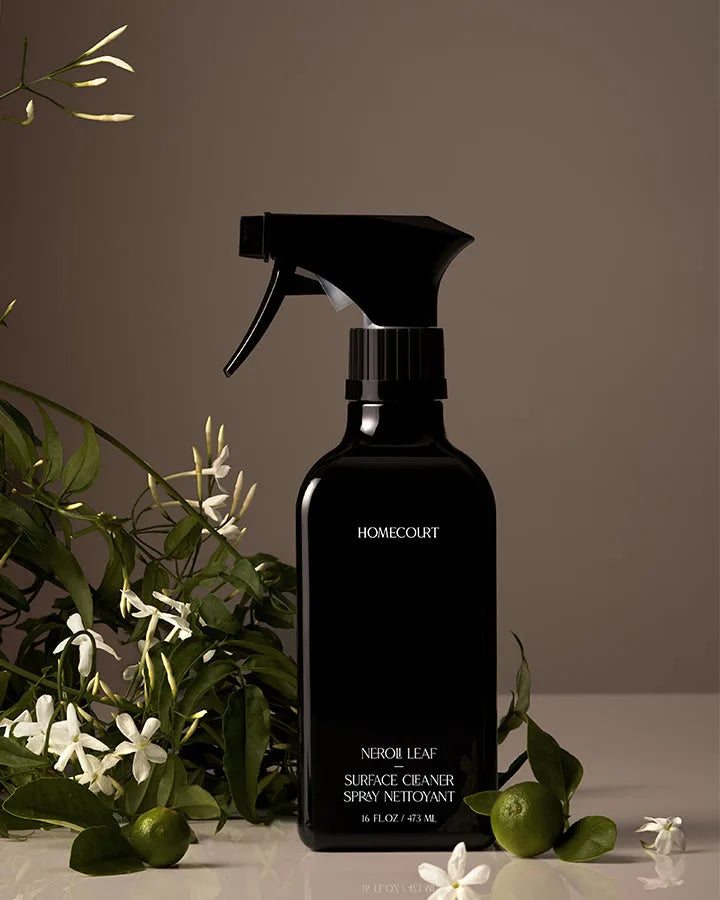
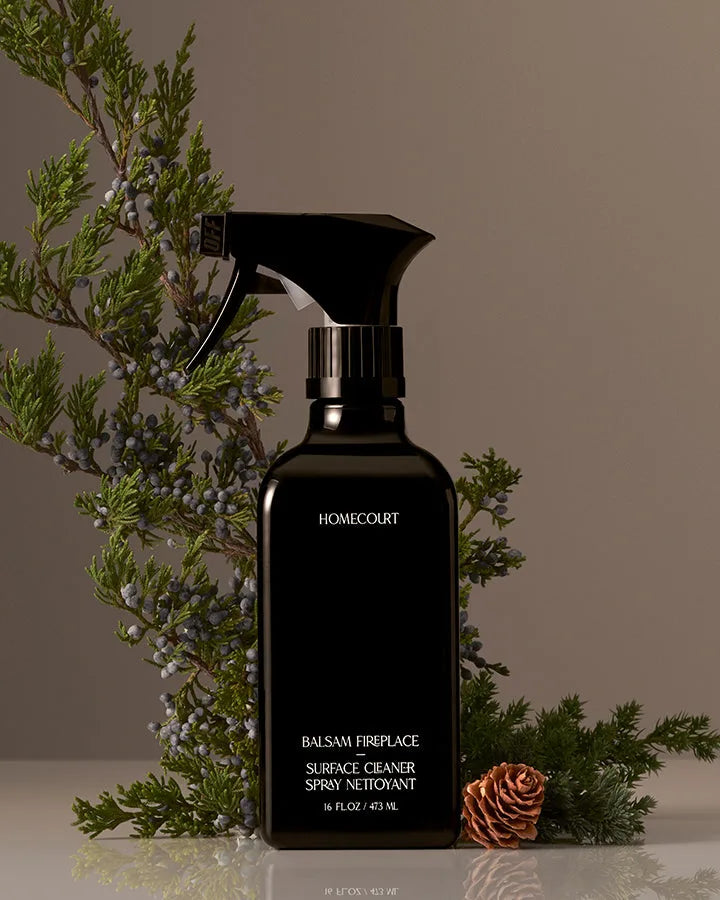
By that test, the best kitchen cleaner is the one whose label matches your counters and lifts grease without a film. Ours describes itself this way: a coconut-derived degreaser that dissolves grease and loosens debris, in a spray its product page says lifts away dirt, smudges and grease without leaving streaks or residue. It costs $26 for 16 oz, and all six scents are in stock today.
When the bottle runs low, the Surface Cleaner Refill is a 1-liter kraft-paper pouch for $46 that refills two bottles and reduces plastic use by 92%, or $41.40 on Subscribe & Save. Our comparison of a non-toxic kitchen cleaner vs vinegar covers what each bottle is for.
Kitchen cleaner FAQ
What readers ask us
Is the Surface Cleaner safe on quartz?
Quartz is not on our label, so we do not recommend the Surface Cleaner there, and Homecourt does not publish a pH figure for the formula. Iowa State University Extension says to clean quartz with a warm, wet dishcloth and to avoid bleach and harsh, acidic cleaners. Use warm water with a drop of mild dish soap, and follow the care guide from your quartz maker or fabricator.
Can you use a kitchen cleaner on wood?
On finished wood, yes, if its label says so, and ours does. Keep any spray off raw or oiled wood, which is porous. For cabinets, check the maker's care guide first, since some ask for a mild dish soap solution only.
Do you need to rinse after spraying?
Our directions have no rinse step. They say to loosen grease and debris with a cloth, then wipe away any excess moisture, and the product page says this non toxic kitchen cleaner leaves no streaks or residue. On stone you washed with dish soap, the Natural Stone Institute says to rinse thoroughly and dry with a soft cloth.
More kitchen surface guides
Keep reading
Cleaners Cleaners
How to Clean Quartz Countertops
Casandra Tayag October 28, 2026 Cleaners